Your Choice: Listen or Read
When I try to picture my studio at this time, what I see is not a clean slate but a kind of productive aftermath. The space still carried the residue of earlier work. In the fall of 1983, I had completed The Time Room, an installation made in collaboration with painter Georgiana Kettler. Elements of that piece lingered—materials stacked, fragments leaned against walls, ideas not yet cleared away. My studio was never a pristine laboratory. It was more like a tide pool, with remnants of one project feeding the next.
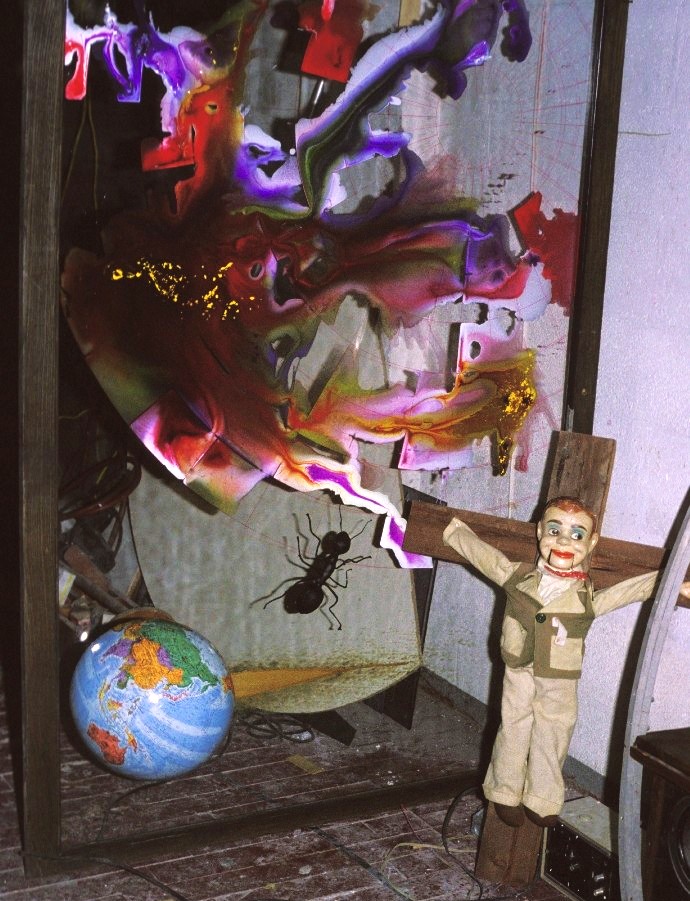
Against the southern wall stood the Timeline Bookcase, near where the pediment piece had been made. I had just disassembled the five sections of the Artpaper roundtable—still leaning against the walls, not yet folded back into storage—and the room carried that feeling of recent, intense conversation.
There were traces of systems-thinking everywhere—structures, sequences, accumulated years—but none of it directly suggested what would become Plato’s Cave. That idea didn’t grow out of objects already in the room. It arrived from somewhere else entirely.
I remember being shaken—not gradually, but all at once—by something I read, or perhaps something I heard on the radio. It may have been an NPR report. What stayed with me was the warning itself: the born-again Christian movement was reportedly within two states of forcing a Constitutional Convention. That was no small procedural detail. Such a convention hadn’t been convened since 1787. The implication was profound and unsettling. The Constitution—something I had always thought of as stable, almost geological—suddenly felt fragile. Conditional. At risk of being reshaped without most people even noticing.
That realization hit me hard. Not panic, exactly, but a sense that attention itself had become a moral responsibility. The erosion I felt wasn’t abstract. It was structural. It wasn’t unlike our current moment, though the pressure was coming from a different direction. The question lodged itself deep inside me: What happens when foundational truths are rewritten while people are distracted, or comforted, or told they are safe?
I kept coming back to an image I’d carried with me for years, long before I knew what I would ever do with it. People seated in a darkened space, watching shadows move across a wall. Mistaking projection for truth. Not because they were stupid, but because it was comfortable. The shadows were familiar. Turning around required effort, risk, disorientation.
Plato didn’t need updating. He needed staging.
What unsettled me wasn’t the lie itself, but how easily the lie could be maintained once people agreed not to look too closely. The allegory wasn’t ancient philosophy to me—it was a diagnostic tool. A way of seeing how persuasion works when it doesn’t announce itself, when it flatters rather than coerces. When it offers certainty in exchange for attention.
That was the moment the cave stopped being metaphor and started being architecture.
Around the same time, just down the hall from my studio, I was becoming friends with Herb Jones, a neon sign artist. Watching him work—seeing language transformed into light—opened a door. Neon had authority. It could command attention without shouting. It could turn text into presence. The convergence was sudden and complete. The idea of Plato’s Cave did not arrive all at once. It took shape in layers, accumulating over time—allegory giving way to architecture, architecture to light, light to shadow, shadow to language, language to law.
I didn’t yet know how to make it. I only knew that it had to exist.
That’s often how it works for me. The impulse arrives as a jolt, but the concept itself assembles over time—fragment by fragment, tested in conversation, clarified through making; the labor and the thinking braided together.
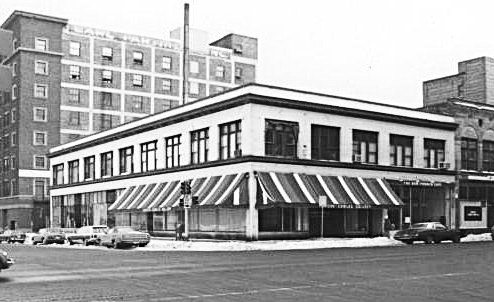
The figuring-out is physical, social, conversational. And for that, I had a resource as important as any grant: the New French Bar. I could walk in there any night and find the people I needed—not specialists hired for a task, but friends willing to push the idea around. Someone would know how to solve one layer of the problem. Someone else would challenge the premise. Ideas didn’t arrive alone; they arrived through dialogue.
People often ask where ideas come from, as if they expect a single source. For me, it never works that way. Ideas come one layer at a time, through reading, through listening, through shared tables and long conversations. They emerge from a network—from attention, urgency, and trust. Plato’s Cave didn’t begin in my studio. It began in my body and then moved outward—until it demanded form.