Your Choice: Listen or Read
If the previous days were about carving the cave into existence, this was about making it believable.
Once the structure was finished, once the scraping stopped, I was standing inside a very white cave. White Styrofoam. Blindingly white. It looked less like a cave than something waiting for occupation. What it needed was dirt—plain, ordinary dirt. The kind you normally get by stepping outside and digging a hole.
Unfortunately, I was on Broadway.
You can’t just dig up dirt in Manhattan. There is no casual ground. Everything is sealed, paved, regulated, or watched. I started by sweeping the streets, which is how I discovered that New York does not actually contain dirt—it contains traces of dirt, carefully rationed. I swept. I scraped. I crouched. I gathered what amounted to a few heroic tablespoons of urban grit while pedestrians stepped around me, politely pretending I wasn’t happening.
This was not going to work. I didn’t need symbolic dirt. I needed volume.
So I went to Roosevelt Island, one of the few places in New York where earth still behaves like earth. I brought two large white buckets with me, empty and hopeful, and filled them with actual dirt—real dirt, unapologetic dirt. Then I carried the buckets to the tram.
The tram operator looked at me. He looked at the buckets. He looked back at me.
I tried to explain. I told him I was building a cave. On Broadway. Plato’s Cave. This did not clarify matters.
There was a pause long enough for me to consider my life choices. Finally, he waved me on, clearly deciding that whatever I was doing was not his problem.
I rode the tram back holding two buckets of dirt, suspended over the East River, rehearsing the sentence I need this to finish a cave in case anyone asked again. No one did.
Back at the museum, I dried the dirt and faced the next problem: how to get it onto the walls.
That’s where improvisation took over.
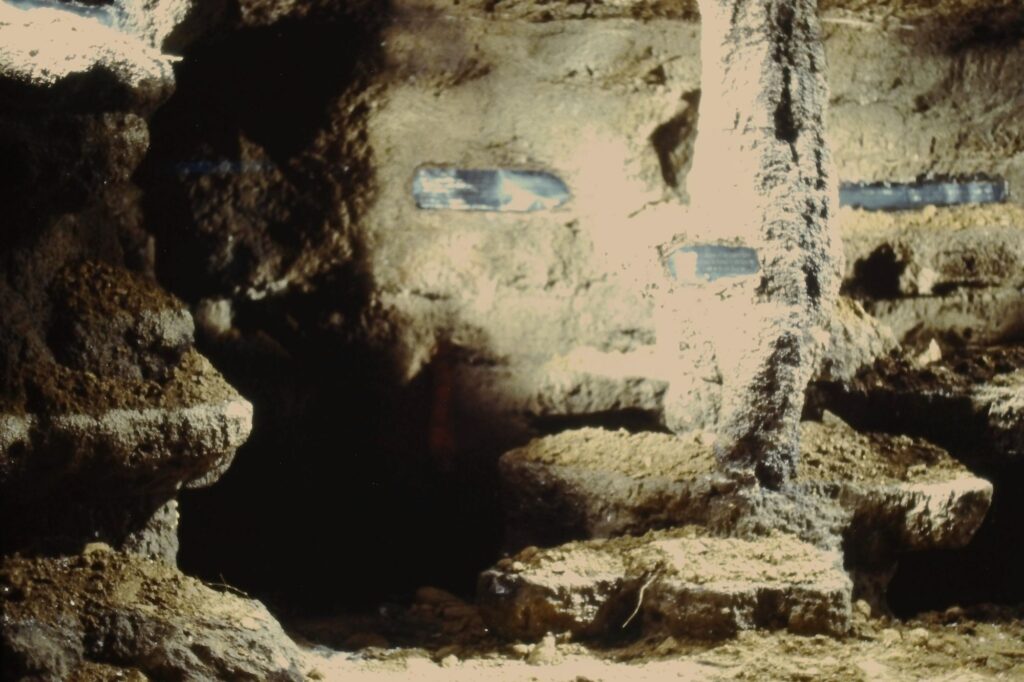
I had a shop vac. I had a dustpan. I had duct tape. I taped the dustpan to the exhaust end of the shop vac and turned it into a dirt blower. There was no manual for this. No approved method. Just glue sprayed onto the Styrofoam and dirt blown into it before it could set.
It worked—barely at first, then better. The cave darkened. It absorbed light. It stopped reflecting and started holding. The white disappeared. The walls began to feel inhabited instead of sterile.
This was how the piece came together—not through specialized tools or professional systems, but through making do. Friends helped when needed. People showed up. Everyone learned as we went.
By the end of it, the cave no longer announced how it was made. It simply existed. The dirt hooking into the glue. The surfaces doing what they were supposed to do. The space holding.
Only later would I recognize how much this way of working stayed with me. Eight years after this, I would be living in New York, leading the digital art movement through artnetweb, working alongside GH Hovagimyan on projects that treated sound, signal, and transmission with the same seriousness I had once given dirt. One of his signature works was called ART DIRT. I couldn’t have named the connection then, but I can see it now. The materials changed. The instincts didn’t.
What I didn’t know yet was that the cave was almost finished—but the work wasn’t.
I had built the conditions.
Something else was about to enter.