Your Choice: Listen or Read
The structure was finished. The language glowed. From the street, the installation read as stable—another fixed presence on Broadway, part of the daily rhythm rather than a singular event. People passed on their way to work, slowed down, leaned in, argued about what it meant. The cave held.
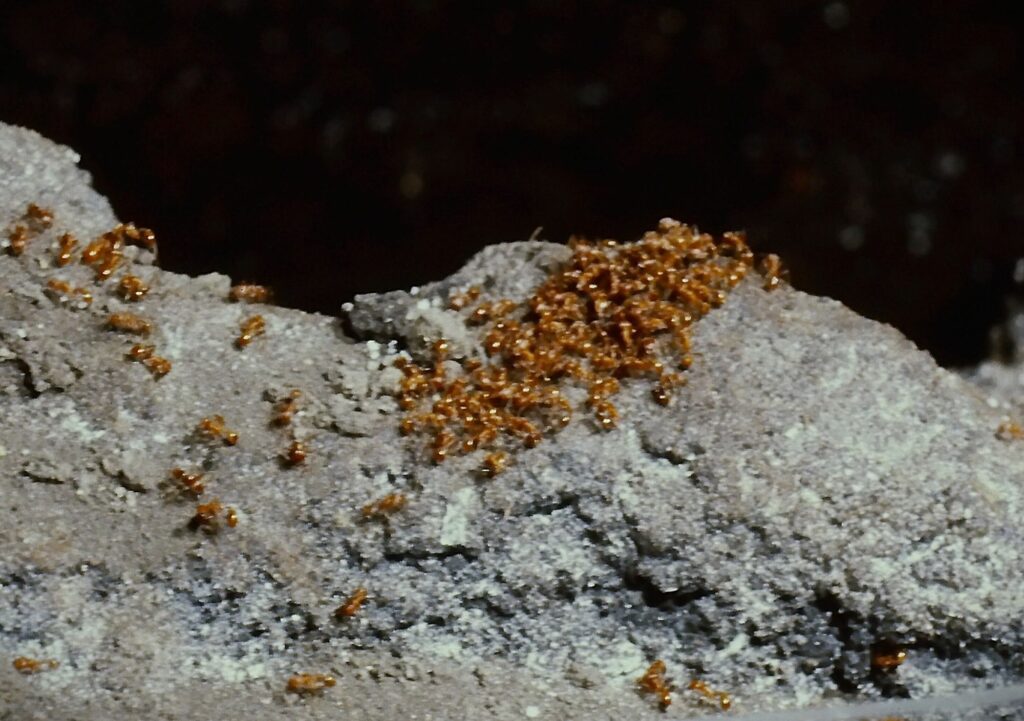
At first, the ants did exactly what I expected. They moved through the space, traced paths, reinforced patterns. They rewrote the work continuously, making it unmistakably alive. I had learned from earlier installations that ants don’t illustrate ideas; they test them. You don’t know in advance what they’ll show you, but you know they’ll show you something.
The show was scheduled for a fixed run—long enough for the work to settle, long enough for patterns to emerge.
Longer than the ants.
There was a condition I understood but hadn’t yet felt the weight of. The ants had no queen.
That wasn’t an oversight. It was the law. You’re not allowed to transport a queen across state lines, and these ants came from Culver City, California. What I installed in the cave was a functioning society with a built-in limit—a system designed to work for a while, then slowly unravel.
For about forty-five days, everything appeared fine. The ants did what ants do. They carried, repaired, followed invisible routes laid down moment by moment. The work breathed. Then one day the New Museum called.
The ants were thinning out.
Could I bring more?
Of course I could. The piece was still alive. Maintenance felt like care, not intervention. I replenished them without hesitation—new ants, fresh bodies, fresh energy—introduced into the same cave.
Only later did I understand what that choice meant.
Ant colonies aren’t held together by memory or loyalty. They’re held together by chemistry—a continuous exchange of pheromones that establishes recognition, belonging, shared direction. Remove a colony from its queen and that chemistry drifts. Introduce new ants into a colony whose chemical language has changed, and recognition fails.
They don’t know each other.
So they fight.
What unfolded in the cave wasn’t misbehavior or chaos. It was precision. I had altered the conditions of a living system, and the system responded exactly as it was built to respond. Inside an allegorical cave devoted to illusion, persuasion, and false consensus, a real breakdown of shared signals played out in full view.
In the window of the New Museum.
On Broadway.
It looked like a war.
I didn’t rush to stop it. I didn’t try to correct it into something more palatable. By then I understood that the work was no longer about what I intended to say. It was about what the system was revealing. Each installation teaches differently. This one taught me what happens when continuity is assumed—when signals are treated as stable long after they’ve begun to drift.
The ants weren’t acting out a metaphor.
They were demonstrating one.
Looking back, it’s impossible not to feel a mix of awe and unease. I had set out to make a work about projection, persuasion, and the fragility of shared reality. The ants took that inquiry further than I could have planned, not by inventing meaning, but by behaving truthfully within the conditions I had created.
No villain.
No ideology.
Just chemistry, attention, and consequence.
The cave did its job.
The language held.
The ants spoke.
They told the truth.