Your Choice: Listen or Read
The show was called Journeys, and that word lingered like a quiet instruction. Not the dramatic kind — no sirens, no neon arrows — more like a whisper: pay attention to where things come from, and where they go. I think that’s when the idea of time as landscape began to take root in me.
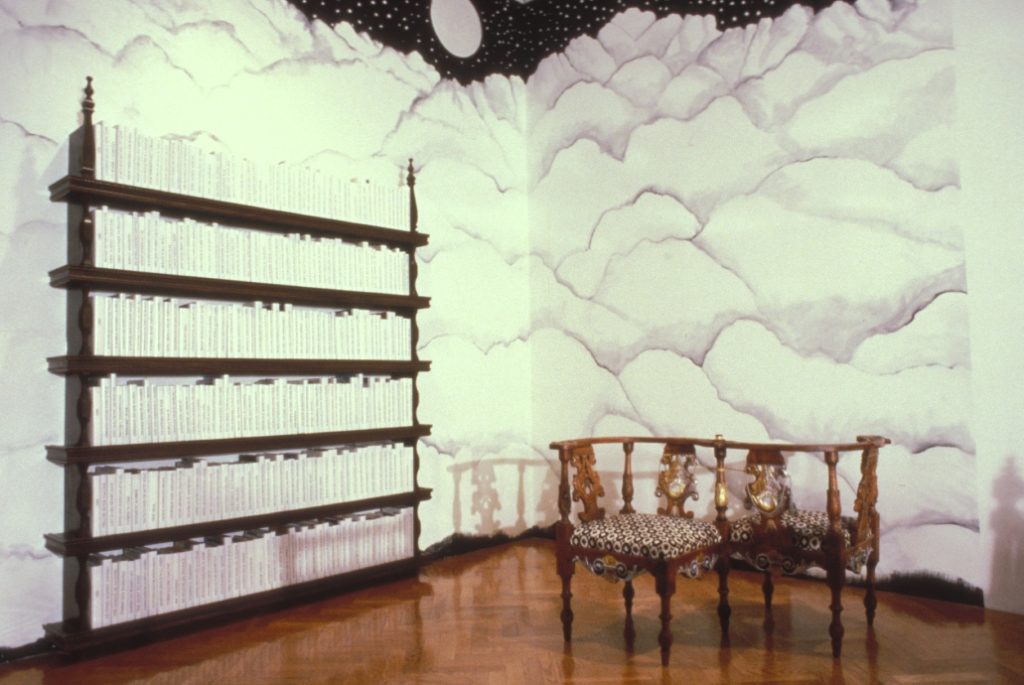
Georgiana was already transforming the top edge of the room into a drifting sky — soft clouds under a dark wash of night, stars puncturing the black like tiny acts of hope. She didn’t paint the whole wall — only the upper band — which meant the sky wasn’t above us, it was encircling us. Containing us. We were inside the weather system of memory.
I started thinking about the furniture.
Not gallery furniture — not white cubes and clean lines — but something older, something that carried the weight of hands and lives that had already moved through the world. The kind of wood that has heard conversation. So I built a six-tiered bookcase, old-world in style, the kind of thing you might expect to find in a grandfather’s study if your grandfather happened to be a historian with a philosophical streak.
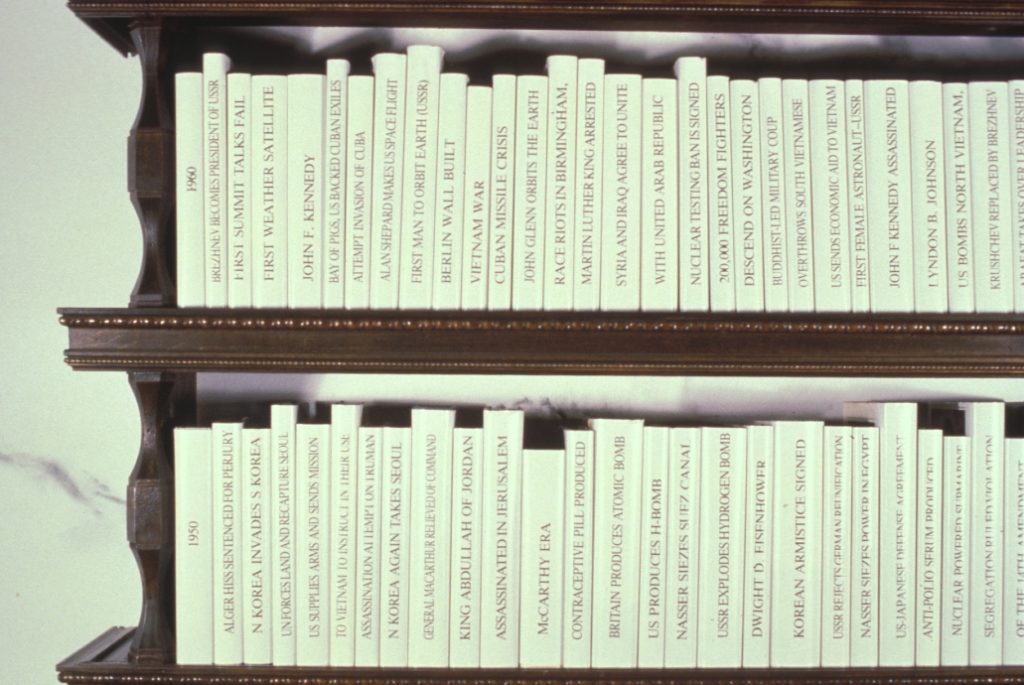
But the books were the real point.
They were ordinary books — but I stripped them of their original skins and gave them new jackets. Typeset titles ran down the spines, clean and consistent, each one not a story but an event:
wars
treaties
discoveries
leaders rising
leaders falling
moments of breakthrough
moments of grief
It was like a library of headlines.
I borrowed language from The Timetables of History — that thick, relentless volume of parallel chronologies — and turned each year into something you could slide from the shelf and hold in your hand. Time became tactile. You could literally reach out and touch it. And yet every title implied motion — a ripple outward through history. It became a kind of fossil record of human action.
Against the sky-painted walls, the bookcase didn’t feel literal at all. It felt like a dream of a bookcase. A place where history went to sleep at night.
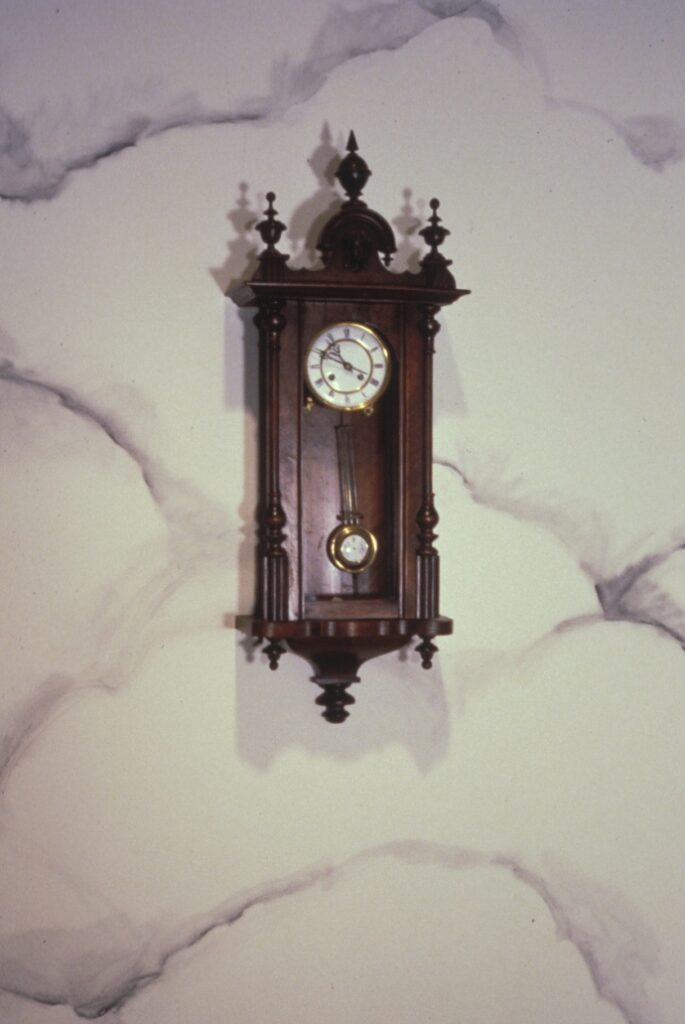
On an adjacent wall, we hung an antique wooden clock against the painted clouds. I didn’t choose it because it was quaint. I chose it because it belonged to time. The pendulum was a small confession: we measure the infinite in small, swinging increments and pretend it makes sense. The clock didn’t dominate the room — it hovered. Like an artifact. Like a witness.
When I stepped back and looked at it all together — the sky, the clock, the bookcase — I began to see what the room was becoming:
Time was no longer an abstract concept.
It had furniture.
It had walls.
It had gravity.
And I was learning, without fully knowing it yet, that I wasn’t simply making objects anymore — I was building environments for thought.
There was something deeply grounding in that discovery. And something risky, too. Because once you realize art can hold time, you also begin to suspect it might hold memory… and grief… and longing… and the parts of life that don’t stay still when you ask them to.
But that part came later.