Your Choice: Listen or Read
This morning I returned to a book I read about six months ago, The Hidden Girl and Other Stories by Ken Liu. The first story in the collection is called Ghost Days. I remembered enjoying it the first time through, but I had forgotten most of the details. What stayed with me was a feeling.
Rereading it this morning, I realized that the story is not really about aliens, archaeology, or even the future. It is about memory. More specifically, it is about the fear that history will forget us—and the hope that it won’t.
As I sat with that thought, I realized it may explain why GH, Adrianne, and I have found ourselves circling back toward one another after all these years.
On the surface, we are talking about ArtNetWeb, the NYC storefront, the BBS, MIT, and the strange energy that surrounded those early days of networked art. We are collecting documents, sharing memories, and trying to reconstruct events that happened more than thirty years ago.
But I think something deeper is happening.
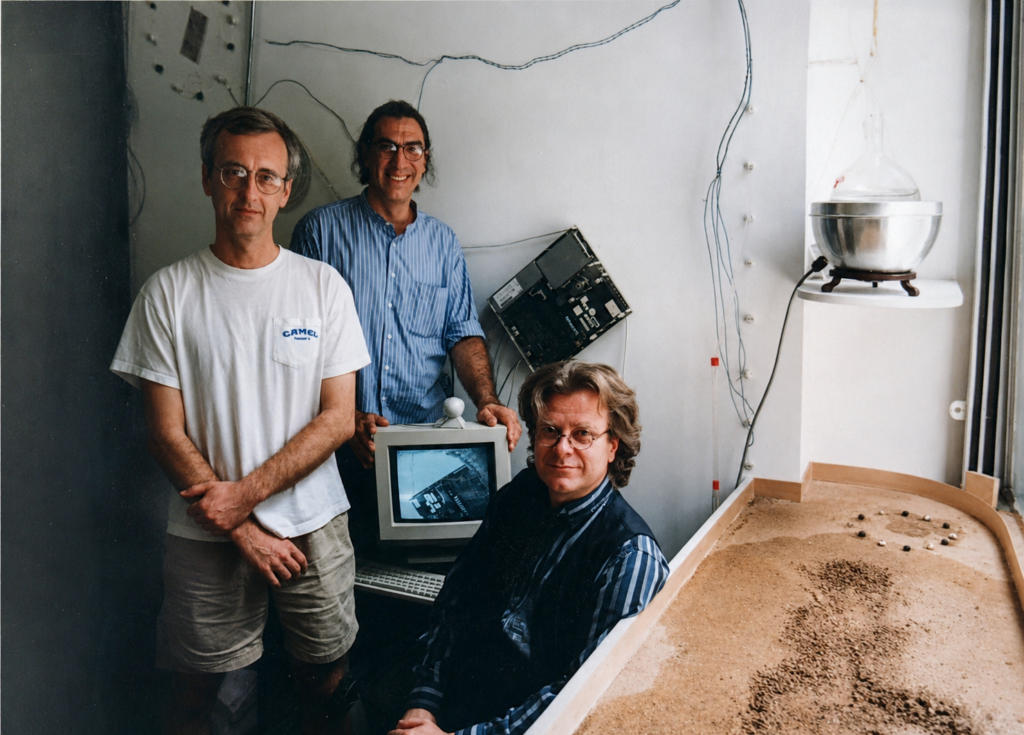
None of us seem particularly interested in proving that we were important. If that were the goal, we could simply list accomplishments and be done with it. Instead, we keep returning to stories, conversations, and fragments of memory. We are trying to understand what actually happened. What was the thing we built together? What did it mean? What traces of it still exist?
At first glance, it might seem that the story revolves around four people: GH, Adrianne, Rob, and me. In many ways we were the core. We carried keys, responsibilities, ideas, and dreams. We spent countless hours together trying to imagine what culture might become in a networked world.
But the more I think about it, the less convinced I am that the real story is the four of us.
The storefront was never only ours.
Artists drifted through. Writers appeared for a season and disappeared. Technologists shared knowledge. Curators stopped by. Friendships formed. Collaborations emerged. People brought ideas with them and carried other ideas away. Some stayed for years. Some stayed for a single conversation.
The storefront was not a monument. It was a crossroads.
Perhaps what we are really trying to understand is not a group of individuals but a network.
And then there is Rob.
Three of us remain. One of us is gone.
The easiest thing would be to say that we want to preserve Rob’s memory. But that doesn’t quite capture it. What I feel is closer to what Ken Liu describes in Ghost Days. The dead survive not as ghosts floating above us, but as influences that continue moving through the lives of others.
Rob is present in the stories we tell, in the decisions we made together, in the projects that followed, and in the ways we each changed because of knowing him.
But the same could be said of many of the people who passed through that storefront.
Their influence remains scattered throughout the network.
In that sense, Rob is not absent.
He is distributed.
Part of him exists in GH. Part in Adrianne. Part in me. Part in artists he mentored, collaborated with, argued with, and inspired. Part in the work itself.
The more I think about it, the more I wonder if our task is not to reconstruct a history but to map a constellation.
The four of us may be some of the brightest stars because we remained connected to one another over time. But the shape of the constellation only emerges when we include the many others whose paths crossed ours.
Perhaps that is why this project feels larger than memory.
As artists, we spend much of our lives making objects, images, performances, and systems. Yet eventually all of those things begin to disappear. Buildings change. Websites vanish. Hard drives fail. Even our own memories become unreliable.
What remains are the stories.
The stories are the lines we draw between the stars.
Reading Ghost Days this morning helped me see that what we may be doing is less like writing history and more like archaeology. We are uncovering traces, comparing fragments, and trying to understand the shape of something larger than any one of us could see at the time.
The surprising part is that this process is not making me feel old.
Quite the opposite.
It makes me feel connected to a younger version of myself who was standing in a storefront in SoHo, convinced that something important was happening but unable to explain exactly what it was.
Perhaps that younger self still has something to teach us.
Perhaps that is why we keep returning.
Not because the past needs saving, but because the future may still have use for it.
And perhaps our role now is simply this: to map the constellation that formed around us before its stars fade from view.
Nice! Very prosaic.