Your Choice: Listen or Read
Florence was still ahead of us — not as a continuation, but as something altogether different.
For now, it was enough to carry this place with us, letting it linger, letting it do its quiet work before the next city made its claim.
Florence came after the hill towns, after days of winding roads and gates that seemed to close behind us as much as open ahead. By then we were moving differently—less like tourists, more like temporary residents who had learned how to wait, how to sit, how to notice when a place was finished speaking and it was time to move on.
The city announced itself all at once. Stone everywhere, but warmer stone. A confidence in the way buildings occupied space. Florence didn’t rise up dramatically like Rome; it settled in, dense and assured, as if it had nothing left to prove. We were staying near enough to walk most places, and the days began to take on a gentle rhythm: coffee, wandering, pauses that turned into hours.
It was in the Boboli Gardens, near the Pitti Palace, that I saw him.
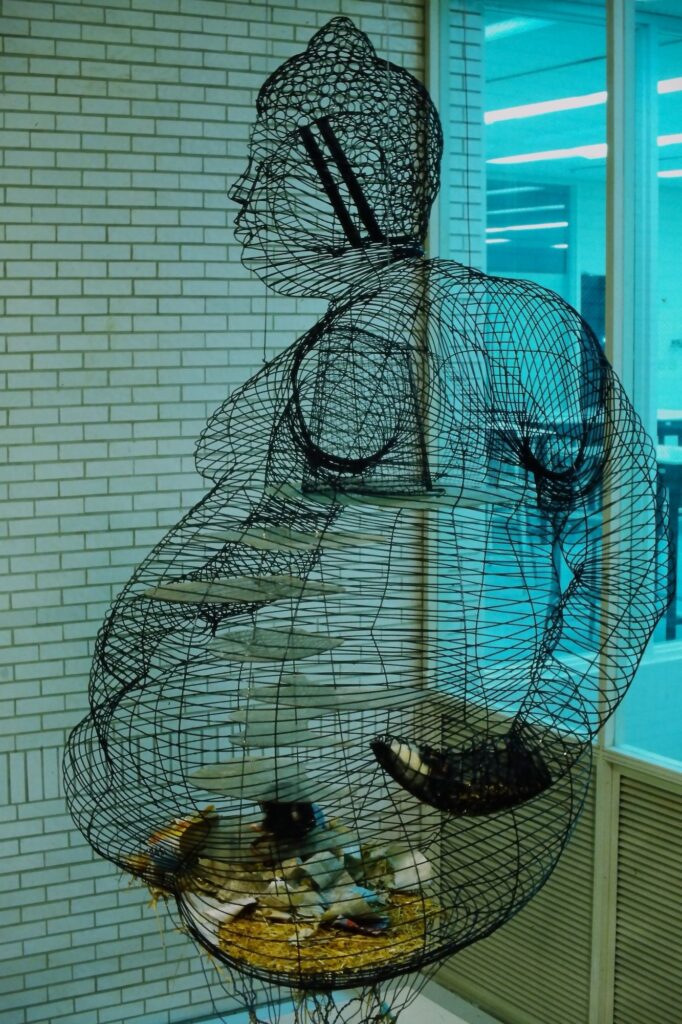
Not a Buddha, exactly—at least not the one people expect—but a fat stone child seated with a gravity that didn’t belong to children. Soft flesh carved in hard material. A body that felt both comic and monumental. He sat there utterly unconcerned with who was looking. I remember circling him slowly, not consciously at first, just responding to the way the form held space. Then I began taking photographs. Not one or two—many. From every angle. Close. Far. Around and around.
I didn’t say much. I didn’t need to. Something had already locked in.
Whether the idea came to me there or whether I recognized something I had already been carrying doesn’t really matter. What mattered was that I knew this form. I knew how it could grow. How it could be transformed. I didn’t yet know why it would need a cage, or what that cage would become, only that the image had weight—and patience.
Florence gave us another small lesson in misunderstanding. We rented a scooter—something that felt instinctive to me, familiar in my body—and followed what we thought were permissible paths into the gardens. The police stopped us quickly. Uniforms, gestures, firm voices. We reached for the translation book, but before I could even open it, Lynn stepped forward.
She didn’t speak Italian fluently—not yet—but she spoke to people. With her hands. With her face. With a kind of openness that invited collaboration rather than defense. She explained, or approximated explaining, that we hadn’t understood the signs. That we meant no harm. That we were trying to learn.
It worked.
The tension dissolved. The officers softened. A warning, a smile, a release. We rode away quietly, both of us laughing—not from triumph, but from relief, from gratitude. It was becoming clear that something was happening to her here. She was relying less on the book, more on herself. Language was no longer something to fear; it was something to lean into.
Florence did that to her. It welcomed her curiosity and gave it room to breathe.
The days passed like that. Museums we didn’t rush. Streets we walked more than once. Meals that stretched longer than planned. She wrote in her journal most evenings, sometimes reading me a line or two, sometimes not. I didn’t ask. It felt private in the best way—like watching someone fall deeper into a place without needing commentary.
When we left Florence, I carried more than photographs. I carried a form that would return with me to Minneapolis, projected onto Styrofoam, carved larger than life, wrapped in wire, soldered into something that would change again and again over the years. The piece would evolve, but its core was already set.
Florence didn’t feel like a turning point at the time. It felt quieter than that. More like a confirmation.
We were still very happy then. Not in a loud way. In the way that comes from shared attention. From learning how to move through the world together—carefully, generously—choosing depth over speed without needing to say so out loud.
When we drove north the next morning, the city receded without drama. It didn’t ask us to remember it.
I knew I would.