Your Choice: Listen or Read
1. Reading Neuromancer Again
A week ago I decided to reread William Gibson’s Neuromancer. The first time I encountered it was probably around 1991 or 1992, a year or two before moving to New York and long before the internet had become part of everyday life. Back then it was one of those rare books that permanently changes the way you look at the world.
Reading it today has been an entirely different experience. To be honest, halfway through I still had very little idea what was actually happening. Characters appear and disappear, alliances shift without explanation, and the plot feels almost deliberately obscured. I kept asking myself, “What are they trying to steal?”
Only later did I realize that the central heist is not about money at all. It is about helping one artificial intelligence merge with another so that together they become something neither could become alone. Once I understood that, something clicked—but not because the plot suddenly made sense. I realized I hadn’t loved Neuromancer because of its story. I had loved it because of its language.
Gibson was inventing words for a civilization that did not yet exist. Cyberspace. Console cowboys. ICE. The Matrix. Those words now seem almost ordinary because we have spent decades living inside the future they helped imagine. In the early 1990s they felt like glimpses through a crack in reality.
That realization made me wonder about our own work. While Gibson was imagining cyberspace in fiction, perhaps we were trying to build places where people could actually experience it. Maybe artnetweb and PORT were never simply about computers. Maybe they were early attempts to invent a culture for a world that was only beginning to emerge.
2. Looking at an Old Photograph
After another evening with Neuromancer, I came across an old photograph from our Broome Street storefront. Rob. GH. Me. On the wall behind us hangs a working computer—not sitting on a desk, but literally nailed to the wall. Its cables spread outward like a nervous system before disappearing into an installation containing thousands of live ants.
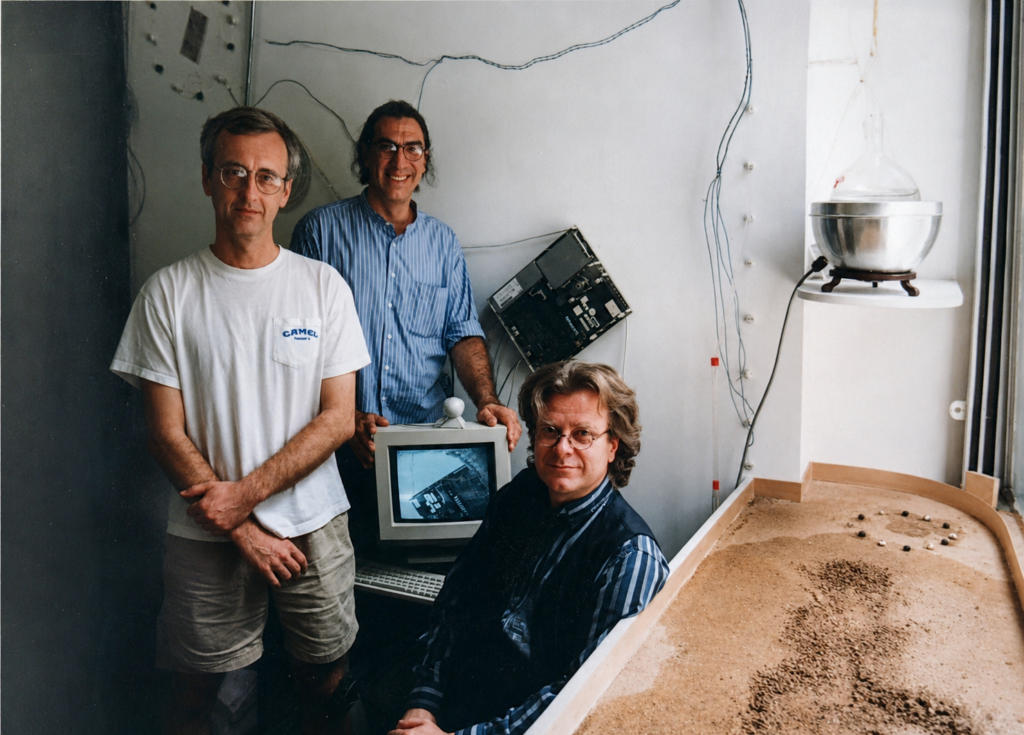
I have looked at that photograph for more than thirty years, but this week I saw it differently.
At the time I probably thought we were making an installation about computers. Today I think we were making an installation about intelligence. Not artificial intelligence or biological intelligence, but intelligence itself.
The ants communicate through pheromones. The computer communicates through electrical signals. Visitors bring language, memory, and imagination. Three different forms of information processing coexist within the same artwork.
In the mid-1990s this felt experimental. Today it feels strangely contemporary. AI participates in our thinking, our phones mediate our conversations, and networks connect billions of people. The rupture between the biological and the digital that fascinated us thirty years ago is no longer a prediction. It has become the landscape in which we live.
Looking back, I wonder whether we misunderstood our own work. Perhaps we were never trying to visualize cyberspace. Perhaps we were asking a deeper question: What happens when different kinds of intelligence begin sharing the same environment? I don’t think we have finished answering that question.
3. Gestation
GH recently suggested the title Gestation for this new series of conversations. The more I think about that word, the more profound it becomes.
At first I assumed it referred to ideas slowly taking shape. Now I think it points toward something much larger. A living organism is not assembled piece by piece like a machine. It emerges through countless interactions until something appears that none of the individual cells could ever become alone.
That is emergence, and perhaps emergence has always been the true subject of our work.
Ant colonies. ArtNetWeb. PORT. Black and white pebbles. The Mary Shelley Letters. Even these conversations among GH, Adrianne, Rob, Molly, and me. None of these projects are really about technology. They are about what happens when many minds become connected and something larger begins to form.
This also changes how I think about AI. Much of the public conversation assumes the goal is to replace human intelligence. I find myself interested in a different possibility. What new forms of intelligence become possible when humans and AI think together over long periods of time—not as master and servant, nor as competitors, but as participants in a shared conversation?
Perhaps that is what we are gestating. We may be creating the conditions for a new way of thinking together.
William Gibson imagined cyberspace before it existed. Thirty years ago we tried to build places where people could experience it. Now cyberspace has become ordinary. The challenge before us is no longer to imagine the future, but to imagine how we might inhabit it wisely. That feels like a worthy direction for whatever comes next.
Great Photo! And yes, it circles around. Maybe you can do both a journal (reflections and set up a Unique room to paste your musings.